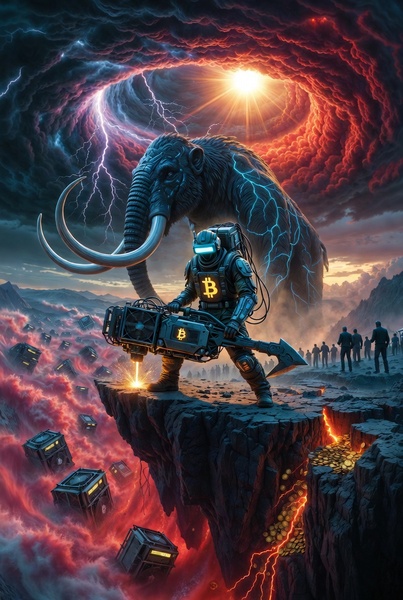
Is This the End of Old Miners? Why is JPMorgan Shorting MSTR?
The last week has revealed a simple truth: the Bitcoin mining industry is undergoing one of the most severe stress tests in its history.
The last week has revealed a simple truth: the Bitcoin mining industry is undergoing one of the most severe stress tests in its history.
Hashprice—the critical metric for miner revenue—has plummeted to the $35–$38 PH/s/day range. Analysts describe this as the harshest margin environment on record. Coupled with mining difficulty near all-time highs, the combination is lethal: more machines are competing for significantly less reward. Everyone is hunting the last 5%.
What This Means Right Now
- Many miners are operating at or below break-even.
- Older fleets are being unplugged.
- Payback periods for new hardware have stretched beyond 1,000 days.
And yet—as counterintuitive as it sounds—this is exactly the environment where sophisticated miners find their biggest asymmetric opportunities. Below, you can see our reasoning and our arguments.
1. The Two Outcomes of Peak Fear
As we discussed internally this week, when the "Fear Index" hits maximum, the market typically resolves in one of two ways. Both favor the efficient miner.
- Scenario A: Price Dips → Difficulty Drops
If the price remains suppressed, inefficient miners (the "weak hands" of the network) are forced to shut down. This causes network difficulty to adjust downward. The result? The miners who remain standing immediately earn more Bitcoin per terahash.
- Scenario B: Price Rebounds → Margin Explosion
This is the "Old Miner" strategy. If the price recovers faster than difficulty rises, margins for existing hardware expand violently.
The Math: Imagine a legacy machine earns $100 but costs $99 in electricity. The net profit is $1.
-If Bitcoin rises just 50%, revenue hits $150. Costs remain $99.
-Net profit jumps from $1 to $51—a 5,000% increase.
2. Volatility: A Feature, Not a Bug
The last 72 hours confirm what Bitcoiners have known for years: volatility is not market noise; it is the mechanism of price discovery.
Fiat currency appears "stable" only because central banks artificially smooth it. Bitcoin, by contrast, is honest. It trades 24/7 without intervention. The price swings we see are the cost of early access to a global monetary asset. As the chart shows: Fear hit extremes, sentiment collapsed, and yet Bitcoin’s core values remain unchanged. Only the fiat price conversion has been deprecated. It's looking like a Black Friday event.
3. The Macro Battle: The Old Guard vs. The New Standard
Recent reports suggest legacy institutions, including JPMorgan, have intensified pressure on Bitcoin proxies like MicroStrategy (MSTR).
This is not a conspiracy; it is a clash of incentives. Traditional banks protect a system based on centralized control. Bitcoin—and companies like MSTR that adopt the "Bitcoin Standard"—represent a financial order based on transparency and mathematics.
It is a reminder of the message Satoshi Nakamoto embedded in the Genesis Block: "The Chancellor on the brink of second bailout for banks." Bitcoin was built as the antidote to this friction.
4. The Long Game
So, the logical question is the following: Why mine in this environment?
Because mining is the only way to acquire Bitcoin permissionlessly—without KYC and without reliance on an exchange. And that corresponds to the old ideals of cypherpunk, and even more importantly, of Satoshi. If you are there, you are active in the revolution. Mining means making the network work. As a foundation pillar. No miners, no network. But not only ideals are important.
History shows that those who deploy hashrate during "Crypto Winter" often outperform those who try to time the market top. If you believe the recent ATH of €125k was not the final peak, the strategy is clear: Zoom out. Keep calm. Keep mining.