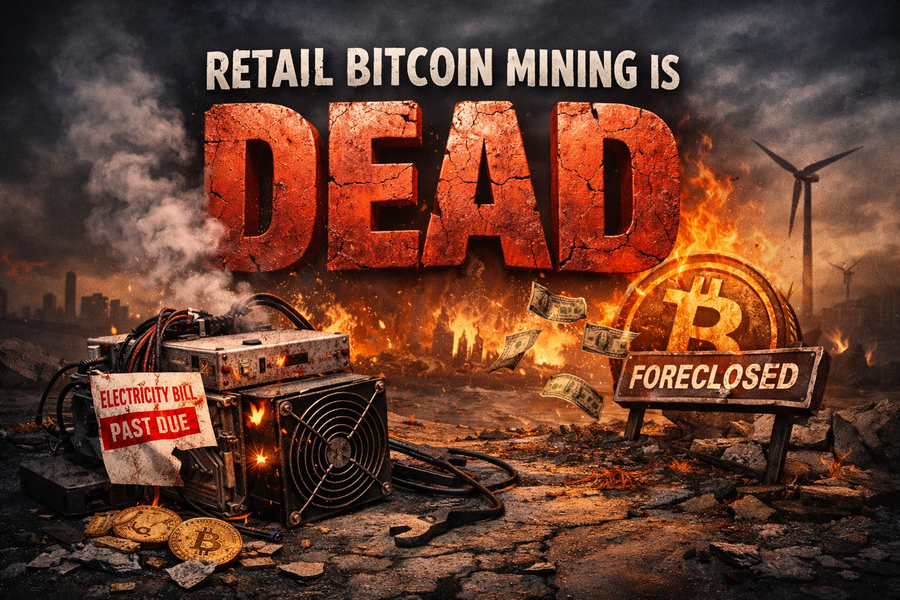
Bitcoin Mining Is Dead. Good.
What’s actually dying is the monthly-bill mining model — here’s what replaces it in crypto winter.
Bitcoin is down hard from the cycle high (~50% from ~$126k ATH), liquidity has been nuked, and the mining economy is getting squeezed.
Miner revenue for the most miner models doesn’t cover the energy — which is exactly the kind of environment where retail hosted miners get emotionally and financially wrecked.
And if you’ve been around long enough, you’ve heard the chorus:
“Retail mining is dead.”
“Hosting is unprofitable.”
“Everyone’s shutting off.”
“Only public miners with deep pockets survive.”
Here’s the part most people miss:
Mining doesn’t “die.” Models die.
The model that dies first in a winter is the one with recurring obligations (power bills, hosting invoices, repair tickets, downtime, logistics) that force you to sell your Bitcoin (no! no! no!) at the worst possible moment, when ₿ is at its lowest.
That’s where Everminer is structurally different.
The retail hosted miner’s pain
If you’ve ever run ASICs the “normal” way (even through a hosting provider), you know the pattern:
1) The bill never stops
Hosting and electricity don’t care about BTC price. When revenue drops and difficulty rises, you don’t just make less — you can go cashflow-negative.
2) Downtime is invisible… until it murders your ROI
A few percent downtime on paper becomes weeks of lost compounding over time. Repairs, firmware issues, pool problems, curtailment events — the list is endless.
3) You’re forced into bad choices
When Bitcoin drops fast, the whole industry feels it. Forced liquidation waves are spreading through crypto markets.
In mining, that translates into: sell reserves, shut off machines, or take worse terms — right when you least want to.
4) Bigger miners can “wait it out.” Retail can’t.
Large miners can restructure, raise capital, pivot capacity, or simply absorb drawdowns. In bear conditions, retail is the marginal seller and the first to capitulate.
So yes — retail hosted mining often becomes disappointing in winter. Not because mining is broken, but because the cashflow mechanics are brutal.
Everminer’s core idea: remove the recurring obligation
Everminer offers lifetime mining services through the purchase of Everhashes, each representing 1 TH/s of mining power. (everminer.io)
Everhash is described as a prepaid computational service contract — “1 TH/s forever” — designed to deliver mining output without the user carrying ongoing operating bills.
In plain language:
Traditional hosted mining
You buy a machine… and then you keep paying to keep it alive.
Everminer
You buy the hashrate contract… and it just keeps producing sats (variable output, but no monthly “keep the lights on” invoice).
This is the key line:
Everminer turns mining from a “monthly survival game” into a “long-duration accumulation tool.”
Everminer in 60 seconds (simple flow)
- Buy Everhashes (minimum is just 1 TH/s lifetime service unit, around 75$ at the moment). (everminer.io)
- Hashrate is delivered directly to your mining pool account.
- Payouts are sent by the mining pool directly to your Bitcoin wallet.
- Mine forever with no ongoing costs. No bills. No downtime. No repairs. No fleet updates. No curtailment.
- or at any moment.. Sell your Everhashes anytime at the internal marketplace. Instantly!
That’s it.
No sourcing ASICs. No shipping. No customs. No repair center. No surprise hosting hikes. No “what if my miner dies tomorrow?”.
Why this model shines in crypto winter
Winter is when the industry’s weakest cashflow structure gets exposed.
1) No monthly bills means no forced selling
Even if sats/day drops with higher difficulty, you don’t face the classic death spiral:
BTC down → revenue down → invoices unchanged → sell BTC at lows → fewer reserves → more stress.
Everminer’s model is designed so your post-purchase operational outflow is not the thing that kills you. Output can vary, but you aren’t fighting a monthly deadline.
2) Winter compresses the entire mining economy
Mining revenue metrics and hardware pricing both tighten in drawdowns.
That backdrop is exactly why “no-recurring-cost” models become psychologically (and operationally) easy to hold for years stress-free.
3) You’re positioned for both outcomes:
- If BTC takes time to recover: you keep accumulating sats.
- If BTC recovers fast: the sats you accumulated revalue upward with the market. AND the price of your Bitcoin generating assets — Everhashes — grow proportionally. Basically, it’s just like a leveraged mining but with no liquidation risks.
4) Liquidity is a feature, not a panic button
Order-book market for EVH contracts (buy/sell, set your rate or trade market) gives you the flexibility to exit at any moment and extra way to earn on trading EVHs.
In a retail world, optional liquidity matters because life happens — but the default posture is still to sit tight and keep stacking.
Let’s say the quiet part out loud:
- Mining output is never guaranteed. Difficulty, fees, uptime, and pool performance all change. You do get some Bitcoin anyways, and no monthly bills — that’s what is guaranteed.
- “Always profitable” depends on what you mean.
Cashflow-positive after purchase? Yes, because there’s no monthly invoice.
Guaranteed ROI on the upfront price? No — that depends on time, difficulty, BTC price and Everhash exit price.
Everminer’s advantage isn’t magic profitability. It’s removing the most common retail failure mode: recurring obligations that force bad timing.
A simple way to describe it to a friend
If you want one clean analogy:
Hosted mining is like a mortgaged AirBnB beachfront rental property, with a six-month high season each year and a huge fixed mortgage payment. In summer it’s great — the other six months you’re sweating to cover payments.
vs
Everminer is like actually owning a long-term rental apartment.
The initial cost is higher. The yield may change, but it’s never negative. The value of the property can grow. You can always sell. And the most important: NO MORTGAGE PAYMENTS to sweat over.
Quick “who it’s for / who it’s not for”
Great fit if you:
- Want BTC accumulation without hardware ops
- Hate recurring invoices and downtime drama
- Prefer survivability + “time-in-the-market” over “timing the market”
Not a fit if you:
- Want to tinker with firmware and play with hardware
- Have access to the absolute lowest $/kWh in Nigeria, Iran or elsewhere.
- Need guaranteed payback schedules
- Don’t accept BTC volatility
Mining isn’t dead — fragile hosted mining is.
Bitcoin is down ~50% from the cycle high, and the broader market has been in liquidation/capitulation mode. Hashprice is near the floor.
This is where retail hosted mining breaks.
And this is where Everminer’s structure matters:
- No monthly power bill panic
- No repair-ticket roulette
- No forced selling at the bottom
- Just sats accumulating over time — with optional liquidity
So yes:
Retail mining is dead. Long live Everminer!
----------------------------------------
This article is for informational purposes only and is not financial advice. Mining outputs vary with network difficulty, fees, uptime, and bitcoin price. Always review current product terms and risks.